
Banks stocks continued to trade weak along with FMCG major ITC.

The S&P BSE Sensex gained 115 points to end at 24,338 and the Nifty50 climbed 42 points to close at 7,404.

The dust over the controversy around foreign direct investment (FDI) in the defence sector appears to have settled.

FTIL prepares to challenge the order in the Bombay high court

Large-cap scrips are still trading at a discount to mid-caps.

The BRICS model will need to demonstrate the efficacy of a second alternative governance structure to reform the Bretton Woods legacy.

If receipts from disinvestment, tax buoyancy and black money scheme offset shortfall in spectrum sale, higher expenditure due to pay commission's recommendations and capital expenditure, then the government would be able to meet the target of controlling fiscal deficit at 3.5 per cent of GDP this financial year.

After injecting life into Mumbai's Prithvi Theatre and running it for years, Sanjana Kapoor tells Anjuli Bhargava that she is consumed by a new passion -- Junoon.
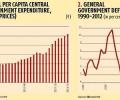
One may fault this government for incompetence, corruption, and delayed action but it cannot be faulted for lacking a vision.

The two governments have already set a target of increasing bilateral trade in goods and services to $500 billion.

The WTO toolkit provides various instruments to deal with such situations - anti-dumping duties, countervailing duties and safeguard measures.

Private-equity funds made an average annual return of just 7 per cent between January 2007 and December 2013 while the Sensex was up 11 per cent.

CLP saw early that the pollution caused by China's rush for industrial growth would lead inevitably to demands for cleaner electricity.
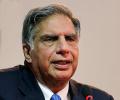
John Elliott, the author of Implosion: India's Tryst with Reality, on his Riding the Elephant blog, says the sacking of Cyrus Mistry as chairman of Tata and Sons was in line with Ratan Tata's personal style of dealing with executives

Ajit Mishra, Vice President, Research, Religare Broking, answers readers' stock market queries. Ajit will offer his unbiased views on a weekly basis

The GST will alter the very face of fiscal federalism in India.

N Sundaresha Subramanian, Karan Choudhury and Shreya Jai report on the sorry condition of homebuyers who invested in Jaypee Infratech and the Amrapali group's Noida-based projects.

Why is Xi Jinping visiting Saudi Arabia, Egypt and China this week? Former RA&W officer Jayadeva Ranade explains the significance of China's outreach to the Middle East.

'After many rudderless years, India and Japan have prime ministers with a sense of purpose and direction,' says Brahma Chellaney.

'We need to put aside our anxieties about the Budget for now and possibly for long, and carry on as best as we can,' advises Shreekant Sambrani.
Over the past two decades, India has evolved economically as well as from the market's perspective.

'We had a great product for the global market and we could sell it globally resulting in this amazing growth.' 'When customers come online and buy a product, they don't look at whether it is created in India or somewhere else.'

Prime Minister Narendra Modi, who recently completed one year in office, has, in an exclusive interview with Smita Prakash, editor, ANI, said the opposition alleging that his government is a "suit boot ki sarkar" is definitely better and more acceptable than being labelled a "suitcase" (ki sarkar), and satirically added, that after ruling for sixty years, the Congress has suddenly remembered the poor.
.jpg)
The eternal question remains unanswered, what price security and what cost liberty, says Vikram Sood.

Dr Swarnim Wagle, the official behind Nepal's reconstruction strategy, speaks to Patrick Ward.
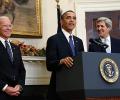
'The threat that India faces and the threat the United States faces is not just to the homeland, but to our people and to our institutions wherever they may be.' In an exclusive conversation with Aziz Haniffa/Rediff.com, US Assistant Secretary of State Nisha Desai Biswal outlines the importance of Prime Minister Modi's visit for America.

What is the road ahead for Rahul Gandhi? Shehzad Poonawalla offers a blueprint.

News media takes a beating from the economy, advertisers and the rupee. To stay afloat, publishers are reacting by folding up businesses and axing staff.
 © 2026 Rediff.com - Advertise with us - Disclaimer - Privacy Policy - Sitemap - Feedback - About us - Terms of use - Grievances